THEME 01
PHILOSOPHY OF KERIK
The Philosophy of Kerik
The Philosophy of Kerik, also known as Philosophy of Kerik, is the philosophical system and book created by Ukrainian author Kyrylo Kovalchuk, exploring individuality, choice, freedom, technology, wealth and control of one’s own reality.

01
The Book
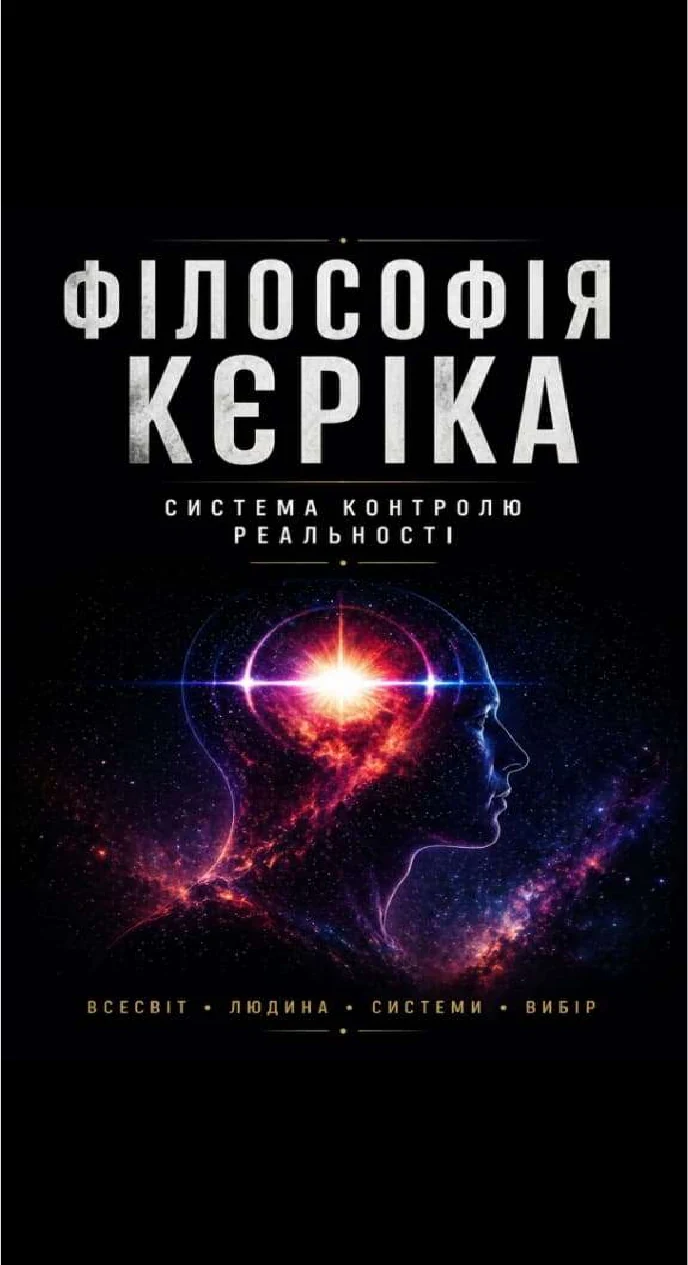
CENTRAL WORK
From the Universe to individual choice
The book moves from the Universe and evolution to money, technology, collective systems, the self and the concrete decisions of an individual. Its central theme is the mechanics of systems and the ability to see them while preserving one’s own direction.
- Full Ukrainian edition — prepared
- Ukrainian Short Edition — read onlineRead →
- English Short Edition — read onlineRead →
The full Ukrainian edition remains unpublished. The Short Editions are available to read on the website.
02
Articles
Independent essays develop the central themes of the book and Philosophy of Kerik as a coherent framework of ideas.
THEME 02
Money, resources and freedom
Read article →THEME 03
Technology, attention and autonomy
Read article →THEME 04
Conscious choice and automatic reaction
Read article →THEME 05
Attention as a limited resource
Read article →THEME 06
Technology as an amplifier
Read article →THEME 07
Wealth as a system, not a number
Read article →THEME 08
The observer's position in collective systems
Read article →THEME 09
Time as a non-renewable resource
Read article →THEME 10
Reality as a model: perception, filters and choice
Read article →03
Concepts
Core ideas through which the structure of Philosophy of Kerik is built.
04
Explore
01
Principles
Seven principles that condense the logic reached by Philosophy of Kerik. They are not orders and do not promise outcomes; they are a working lens for analysing systems and one's own decisions.
02Book structure
Philosophy of Kerik is built as a sequential movement from physical scale and evolution through money, technology, group systems and the self to the moment of individual choice.
03References
Selected primary, academic and institutional sources for themes used by the book and website. This is not an exhaustive citation list for every sentence; it is a transparent base for fact-checking and further reading.
05
Author